

Single-use hollow-carrier perforating system for deployment on wireline or on tubing, coiled tubing (CT).

| Parameter | Value |
|---|---|
| Outer diameter, mm | 51 |
| Minimum drift diameter of downhole equipment, mm | 61 |
| Maximum allowable operating temperature, when held for 1 hour, °C | (170-200)±51) |
| Maximum allowable hydrostatic pressure, MPa | 80-1402) |
| Maximum carrier diameter after perforator firing, mm: | |
| in a liquid environment | 53 |
| in a gas environment | 57 |
| Section length, m | 1/2/3/4/5/6 |
| Maximum length of intervals perforated in one run, m: | Limited by the maximum lifting height of the suspension sheave (when deployed on wireline) or by the load capacity of the CT and plate used (when deployed on CT) |
| Specific mass of a loaded section, kg/rm3) | 9.1 |
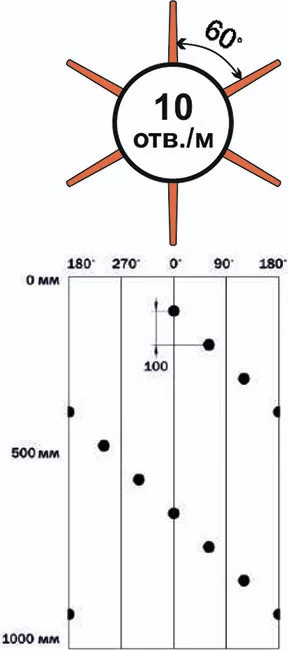
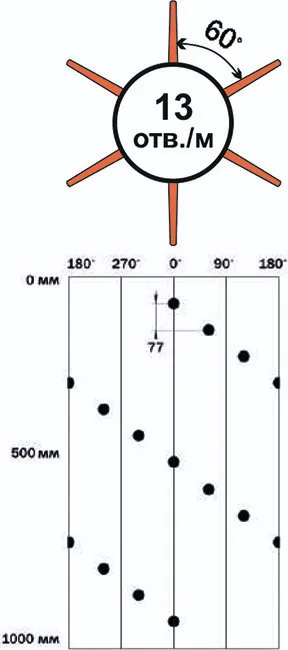
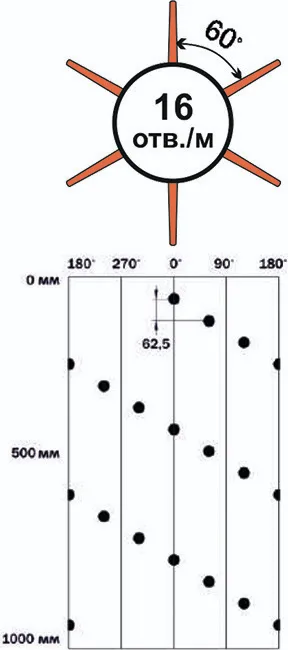
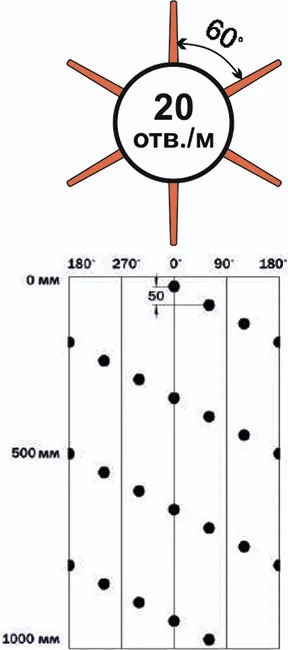
| Phase orientation of charges, deg.4) | 60 |
|
1) The maximum allowable operating temperature and holding time of the loaded perforator are determined by the operational documentation for the EM (explosive materials) having the lowest allowable application temperature compared to the other EMs included in the explosive train of the perforator, as well as by the characteristics of the rubber products used. 2) The maximum allowable pressure may vary depending on the mechanical properties of the carrier tubes. 3) Mass of a running meter of a fully loaded section excluding the mass of reusable elements. 4) Phasing can be changed by special order. |
|
| Shaped charge name | Charge type | Total explosive mass in charge, g | Perforation density, shots/m / phase angle, deg. | ||||
|---|---|---|---|---|---|---|---|
| Average penetration performance parameters of the charge, mm | |||||||
| QC-type composite target performance | API19B performance | ||||||
| Penetration depth | Entrance hole diameter | Penetration depth | Entrance hole diameter | ||||
| ZKPO-PP-3DP | DP | 2.1–3.81) | 20, 15, 12, 102)/ 60 |
300 | 5.5 | 241 | 4.4 |
| ZKPO-PP-6BH-00 | BH | 5.8–7.2 | 120 | 12 | - | - | |
|
1) Depending on the explosive used in the charge. 2) Maximum perforation density in a gas environment. |
|||||||
We are always available and ready to answer your questions
Fill out the form and we will contact you within one business day